


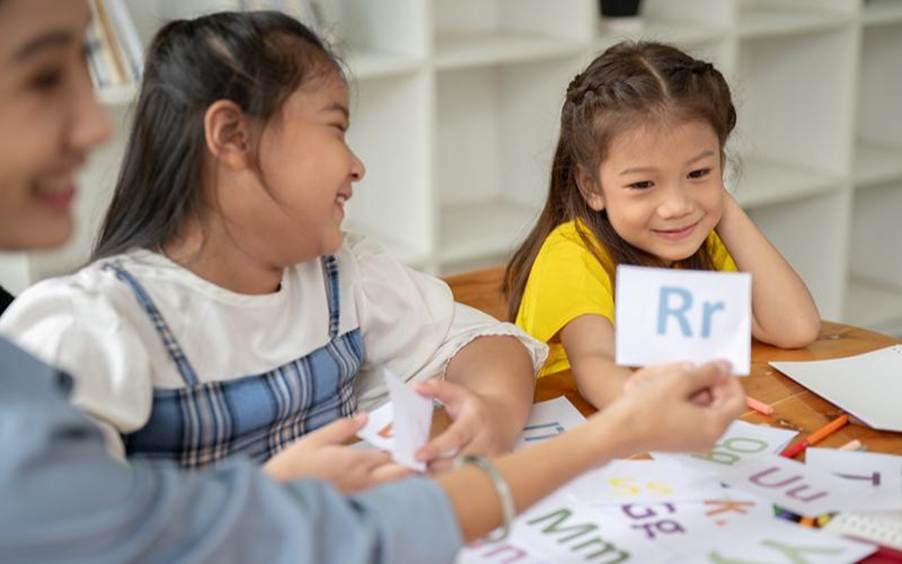
The Reggio Emilia approach in Singapore values children as curious, capable learners who build understanding through play, inquiry, and relationships. By providing children with two rich languages for ideation, negotiation, and documentation, a bilingual preschool may further this ideology. Families often want clarity on what this looks like each day. The following sketch demonstrates how Reggio concepts might be applied to create multilingual classrooms that are challenging, enjoyable, and culturally aware.
1. Environment as the Third Teacher
Reggio classrooms treat space as part of pedagogy. In a bilingual preschool, labels, provocations, and documentation appear in two languages at eye level. Teachers rotate materials to invite investigation, from light tables to natural loose parts. Quiet nooks support reflection, while studio corners encourage collaborative making. Children have the freedom to travel between locations, which fosters resource management and planning skills.
2. Co-teaching for Two Languages
Bilingual teams plan together rather than splitting language time into rigid blocks. One teacher leads in English while a partner extends ideas in the partner language, then they switch roles across the week. This keeps concepts continuous and avoids translation drills. Children hear authentic adult talk around the same inquiry, so vocabulary grows with meaning, gesture, and action.
3. Projects That Grow From Children’s Questions
Inquiry projects begin with observation. Teachers notice a child’s fixation on shadows, transport, or rain, then seed questions and materials. In bilingual Reggio settings, children hypothesise, sketch, and negotiate in both languages as the project matures. The class invites families to share expertise, such as a parent who works at an airport or gallery. Projects last weeks, allowing revisits, redesigns, and public sharing.
4. Documentation That Makes Thinking Visible
With the Reggio Emilia approach in Singapore, educators value the traces of learning. Educators capture photos, transcripts, and artefacts to narrate learning. In bilingual programmes, documentation boards sit side by side in two languages, not as direct copies but as faithful equivalents. Children dictate captions, select images, and help assemble portfolios. Families can follow progress, which strengthens home–school language ties and sparks conversation after pickup.
5. Provocations That Respect Culture
Singapore’s mix of languages and traditions suits Reggio’s focus on local context. Teachers curate provocations that honour festivals, neighbourhood stories, and family routines. Children compare scripts, songs, and idioms, noticing sound patterns and forms. Cooking, market visits, and sign hunts anchor vocabulary in lived places. Thoughtful curation avoids tokenism and invites children to see community life as a valid source of knowledge.
6. Assessment Through Habits of Mind
Instead of grades, Reggio educators track dispositions such as persistence, collaboration, and precision. In bilingual settings, teachers note how children switch registers, use context clues, and borrow structures from one language to build meaning in another. Checklists, learning stories, and samples provide evidence. Families receive narratives that describe growth and next steps, so targets feel concrete and child-centred.
7. Care Routines as Language Moments
Arrival, snack, and tidy-up carry powerful language opportunities. Teachers model short, consistent phrases in both languages and use visual cues so children can act independently. Predictable routines build confidence and free attention for inquiry. Children practise polite forms, questions, and time words through real needs like serving fruit, sharing tools, or sequencing steps for handwashing.
8. Educators as Researchers and Partners
Reggio teams study their own practice. They meet to analyse transcripts, refine prompts, and adapt environments. In bilingual preschools, teams also audit language balance and interaction quality. They ask whether quieter children receive wait time or whether one language dominates during complex tasks. Families join ateliers, share songs, and lend materials, while communication tools offer two-language updates that are short and regular.
Conclusion
The Reggio Emilia approach in Singapore works best when bilingual classrooms weave inquiry, culture, and documentation into everyday habits. Children meet ideas through two languages, practise expressing complex thinking with peers and adults, and gain confidence from visible progress. Families receive windows into learning and invitations to contribute materials, stories, and home languages. Teachers adjust environments, prompts, and language moves through reflective study that treats evidence as guidance, not paperwork. When you visit a bilingual preschool, look for co-teaching in action, documentation, and spaces that invite investigation. These signals show a community ready to nurture kind, capable learners.
Contact Apple Tree Playhouse to book a classroom tour with live co-teaching, review bilingual documentation samples, and receive a take-home inquiry pack so your child can try a two-language project before enrolment.
